





AI (Artificial Intelligence) is everywhere these days. It has become such a broad umbrella term that people sometimes get confused about where it ends, where traditional automation begins, and where the two overlap. In online marketing, Booking Boosters combines both technologies to make marketing work more efficient, improve performance and save time.
What is AI?
The term AI used to cover all sorts of things, such as machine learning and deep learning. The current hype is mostly about Generative AI and Large Language Models (LLMs), such as ChatGPT, Claude and Gemini. Put simply, these AI models understand context and generate new content (such as text, images or data analyses) based on an instruction (a prompt).
In marketing, this is ideal for help with optimising copy, summarising long analyses or editing images. For example, AI can remove a distracting object from the background of a photo or turn a cloudy day into a sunny one. The creative possibilities with AI are endless, but it’s important to use it responsibly. That’s why we always take the applicable rules and regulations into account when generating and editing images.

What is automation?
Automation is also a broad term, but at its core it’s a digital conveyor belt. It’s a system set up with fixed rules: if this happens, do that. It automatically carries out a specific task as soon as a certain “trigger” goes off.
Think of an automatic message sent to the right marketer or campaign manager as soon as there are problems with ad spend. Or a script that searches every page of a website for a specific promotional sticker or text that needs to be removed after a holiday period. Automation can also process large amounts of data to quickly produce visual insights. Automation doesn’t think. It blindly follows the rules.
The biggest difference: rules versus context
The main difference lies in flexibility and the ability to “think”. Automation does exactly what it has been programmed to do, without assessing the situation. Say an automation has been set up to end every sentence with an exclamation mark (!). If a sentence already ends with an exclamation mark, the automation coldly adds another one.
AI, on the other hand, understands context. With a good instruction, AI sees that there’s already an exclamation mark and simply skips that sentence. Automation excels at repetition and flawless precision. AI excels at understanding and flexibility.
The perfect match: AI and automation working together
The real magic happens when you combine the two. You can use automation to do the groundwork, and then AI takes over the thinking.
A concrete example is automatically checking hundreds of ads for spelling mistakes. The automation part pulls all active ad copy from Meta (Facebook and Instagram) or Google Ads and lines it up neatly. The copy is then sent to the AI, which reads it, understands the grammar and picks out the spelling mistakes straight away. Because marketers no longer lose valuable time on manual checks, they have more room for quality work. That time can go straight into making content more distinctive and sharpening the campaign strategy.
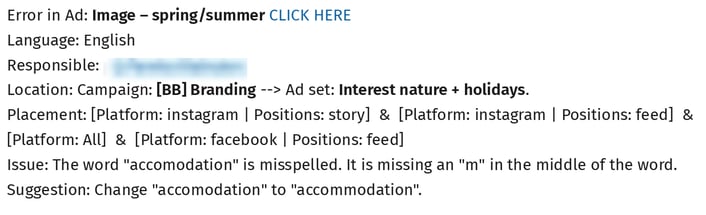
Automation and AI work together to find a spelling mistake in a Meta ad
When should your business use which?
As a rule of thumb: is a task repetitive, monotonous and based on clear, fixed steps? Then it’s perfect for automation. Imagine a holiday park is fully booked for a holiday period. An automation spots this straight away in the booking system and sends an alert so the running ads for that period can be paused. This prevents unnecessary ad spend. That budget can then go straight into ads or campaigns for periods that still need attention.

An automatic alert for a fully booked period
The next step: smart AI agents
AI is still often used on its own to quickly write an email or look something up. Combined with automation, though, it becomes a strategic tool for working even more efficiently. Thanks to the rise of MCPs (Model Context Protocol), AI models can now “talk” directly to the software, databases and systems (APIs) already running within an organisation.
This allows Booking Boosters to build advanced AI agents that act as the ultimate assistant for marketers. Instead of spending hours digging through complicated dashboards to analyse data, a marketer simply asks the AI assistant in plain language: “Which ads are underperforming right now and need attention?” The AI understands the question, triggers the right automation (the “tool”) to fetch live data from Google or Meta, and lists the main bottlenecks and opportunities. Marketers can then get straight to work with the right data to make campaigns more distinctive, reach the target audience better and improve performance. The AI agent does the groundwork at lightning speed, so the marketer can make the changes that have the most impact.

SEAn, Booking Boosters' SEA AI-Assistent
Want to talk through the possibilities?
Do you have questions about this, or would you just like to talk through what an AI assistant could do for your marketing strategy? Get in touch with us.